Bremont Is Sending a Watch to the Moon's Surface
When astronauts next set foot on the moon—NASA is aiming for 2028, China for 2030—a British-made watch may already be there waiting for them, having spent years traversing the lunar surface.
The Artemis II crew each received an Omega Speedmaster X-33 for their mission, the digital astronaut watch that has served NASA for decades. Omega's analog Speedmaster Professional "Moonwatch" famously accompanied Apollo astronauts to the lunar surface in 1969, and Commander Reid Wiseman reportedly brought a traditional Moonwatch along for Artemis II as well.
But Omega doesn't hold exclusive rights to what astronauts wear on their wrists. Three Breitling Navitimer Cosmonaute watches—modern versions of the timepiece astronaut Scott Carpenter wore orbiting Earth in 1962—were reportedly aboard Artemis II as personal items. Yesterday, Breitling unveiled a limited edition Navitimer Cosmonaute Artemis II with a blue meteorite dial.
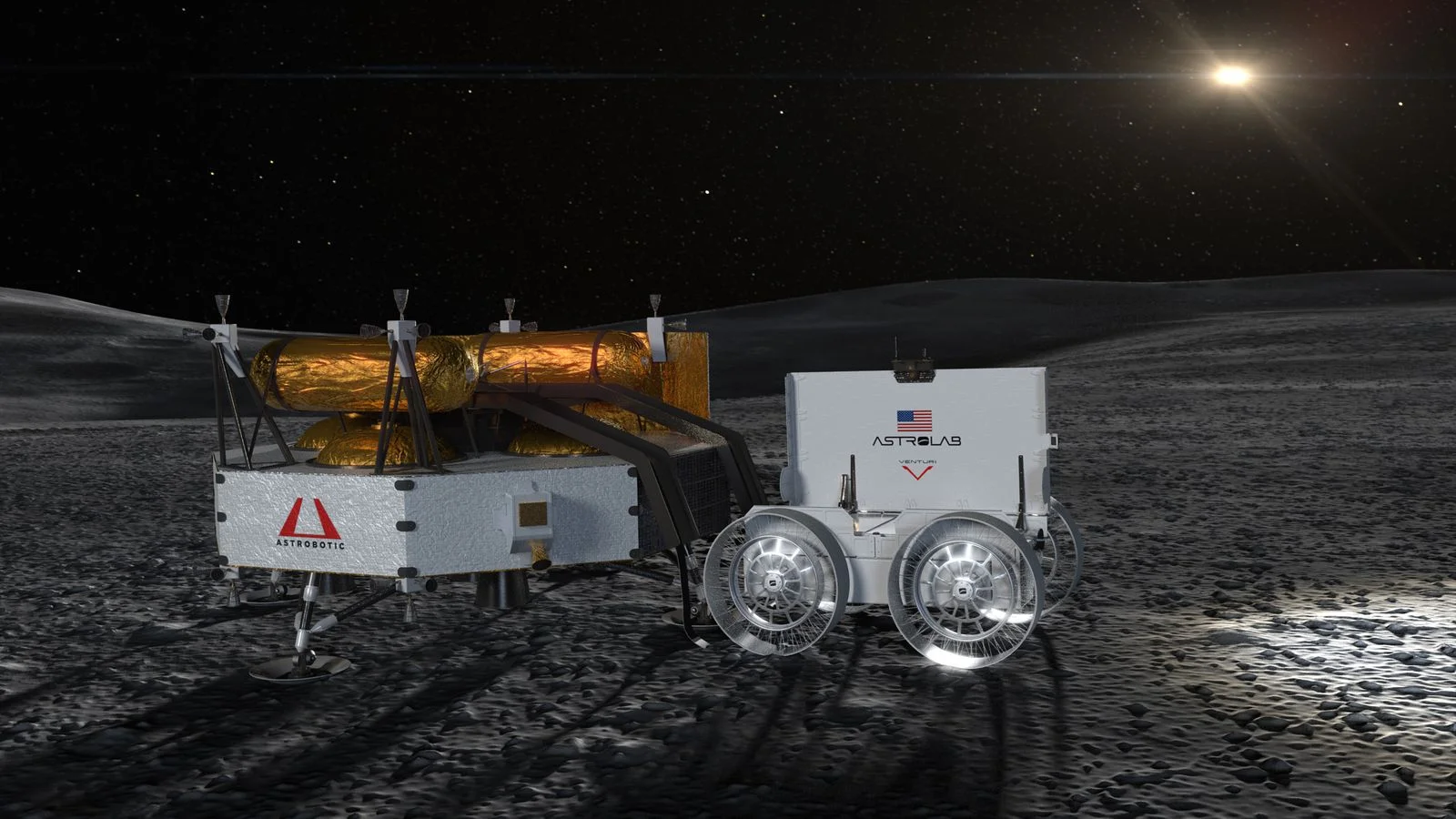
Neither Swiss brand, however, will be first back to the moon. In an echo of the moment Rolex attached a specially built watch to the hull of a submersible that descended to the Mariana Trench in 1960, Bremont's Supernova Chronograph will be mounted to the chassis of Astrolab's FLIP rover when it lands on the lunar surface later this year. The California aerospace startup's Flex Lunar Innovation Platform will carry the British watchmaker's timepiece into territory no wristwatch has occupied in over half a century.
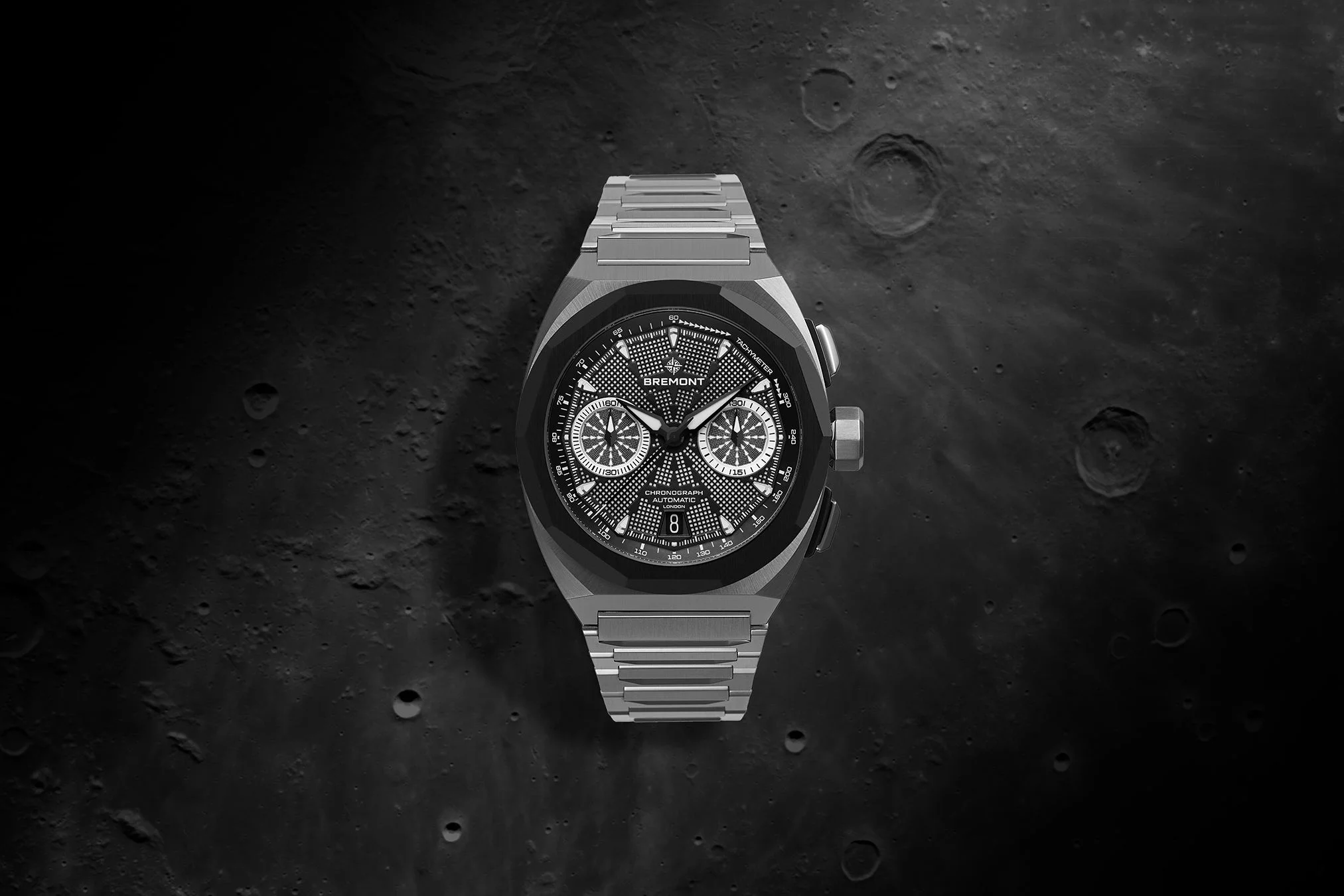
The Supernova, a 41-mm integrated-bracelet sports chronograph in 904L stainless steel, marks the debut of an entirely new, futuristic space-inspired collection from Bremont, the British watchmaker now owned by Wall Street investor Bill Ackman. Its three-dimensional perforated dial draws inspiration from spacecraft solar sail geometry: an interlocking grid set over a full layer of blue-emission Super-LumiNova that glows in low light with what Bremont CEO Davide Cerrato describes as "the energy inside spaceships, or light-speed acceleration in Star Wars."
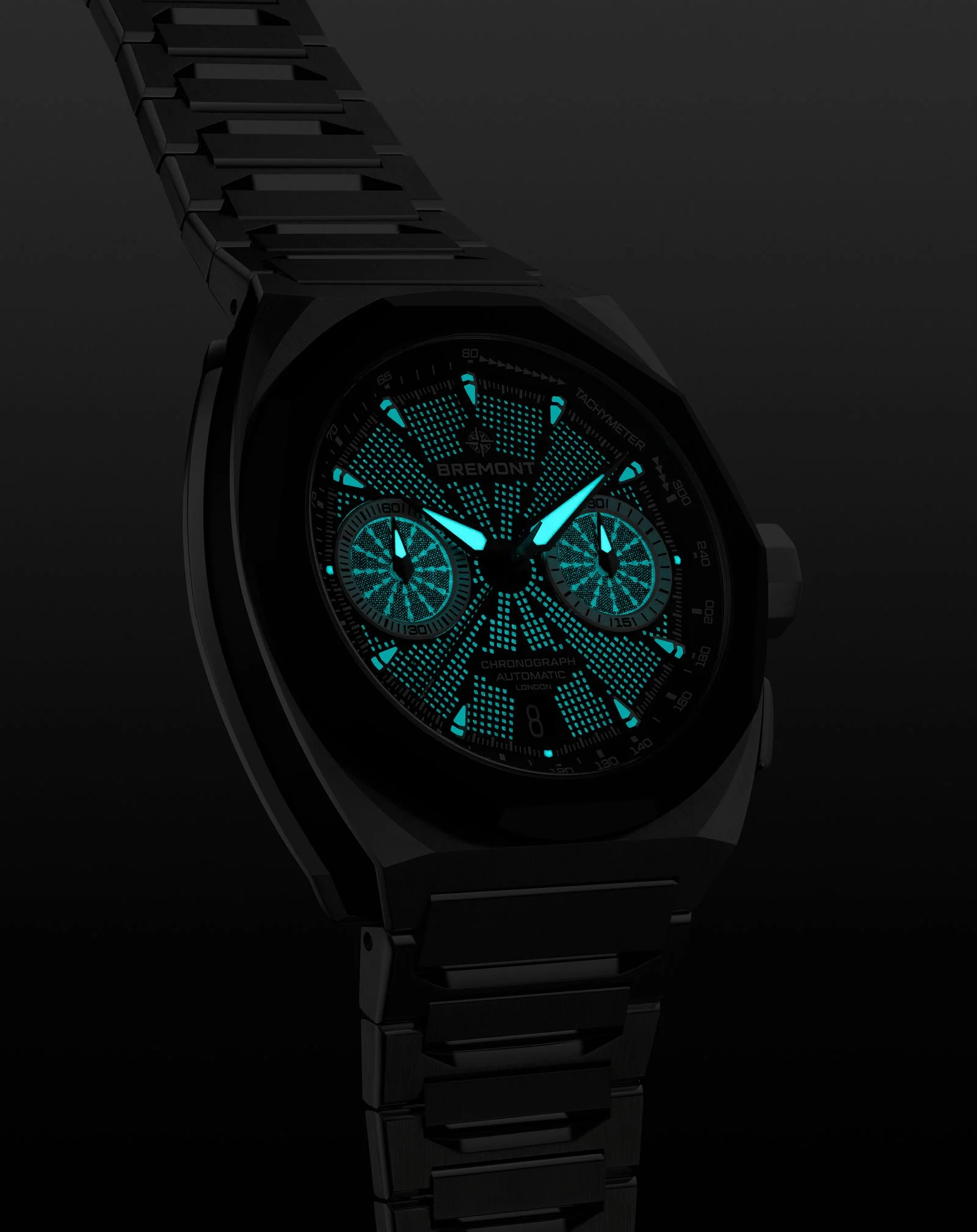
A multifaceted decahedral black ceramic bezel and sandwich-style three-piece case—a reworking of Bremont's signature Trip-Tick construction—house a chronometer-rated automatic chronograph movement made by Sellita, with a 62-hour power reserve.
The watch will travel aboard the FLIP rover, scheduled to launch as part of Astrobotic's Griffin Mission One, expected to land at the lunar south pole in the second half of this year.
It's a one-way trip. The rover will remain permanently on the lunar surface, with the watch ticking away as it roams the landscape. FLIP's objectives include reaching elevated terrain positions, gathering data on lunar dust accumulation, testing dust-mitigation coatings, and surviving a two-week lunar night in hibernation—which would be a first for a US rover.
As a serious timekeeping experiment, the mission is largely symbolic. The watch will be mounted vertically in a specially designed housing within FLIP's chassis, between its front wheels. Only the 107-gram watch head is included, glued in place using a specialist composite, its face visible to FLIP's HD cameras. But the hibernation periods will cause the watch—whose mechanical movement is driven by the wearer's arm motion under normal circumstances—to stop once its 62-hour power reserve runs down.
When FLIP resumes movement, its motion should theoretically jolt the mechanism back to life. Despite the moon's gravitational pull being one-sixth of Earth's, the rover's acceleration, pitches, and tilts should swing the winding rotor, albeit with less torque and efficiency than on Earth.
"My guess is that the watch will function from time to time, but for short periods," Cerrato says. "We will learn along the way. But that's what is exciting—it projects us into a thinking process that is absolutely out of the box. Just the fact of having it there is inspiring." Bremont will, like other brands with cosmic connections, undoubtedly leverage its new space credentials extensively.
FLIP itself, weighing just 1,058 pounds and carrying a mix of commercial and government payloads, four HD cameras, and a deployable solar array, is fundamentally a technology demonstrator for Flexible Logistics and Exploration (FLEX), Astrolab's much larger SUV-sized rover destined to support NASA's Artemis program. The firm developed FLIP from scratch after NASA's equivalent vehicle for which the Griffin-1 mission was contracted, the VIPER, was put on pause in 2024. This left Astrobotic seeking a replacement in short order. Astrolab, which signed the contract within a month of hearing about the opportunity in fall 2024, took FLIP from blank sheet to finished rover in roughly a year.
Its standout feature is its hyper-deformable wheels, minutely structured from silicone, composite, and stainless steel, which create a soft, enlarged contact surface with the terrain. "It's like if you're off-roading in a Jeep or Land Rover where you let some air out of the tires to go softer and spread the load over a larger area," explains Astrolab founder Jaret Matthews. While the moon's nighttime temperatures of around -200 degrees Celsius (around -328 Fahrenheit) would cause conventional rubber tires to become glass-like and shatter, Astrolab's solution is designed to keep the rover from sinking into the unconsolidated lunar dust—or regolith—that covers the environment.
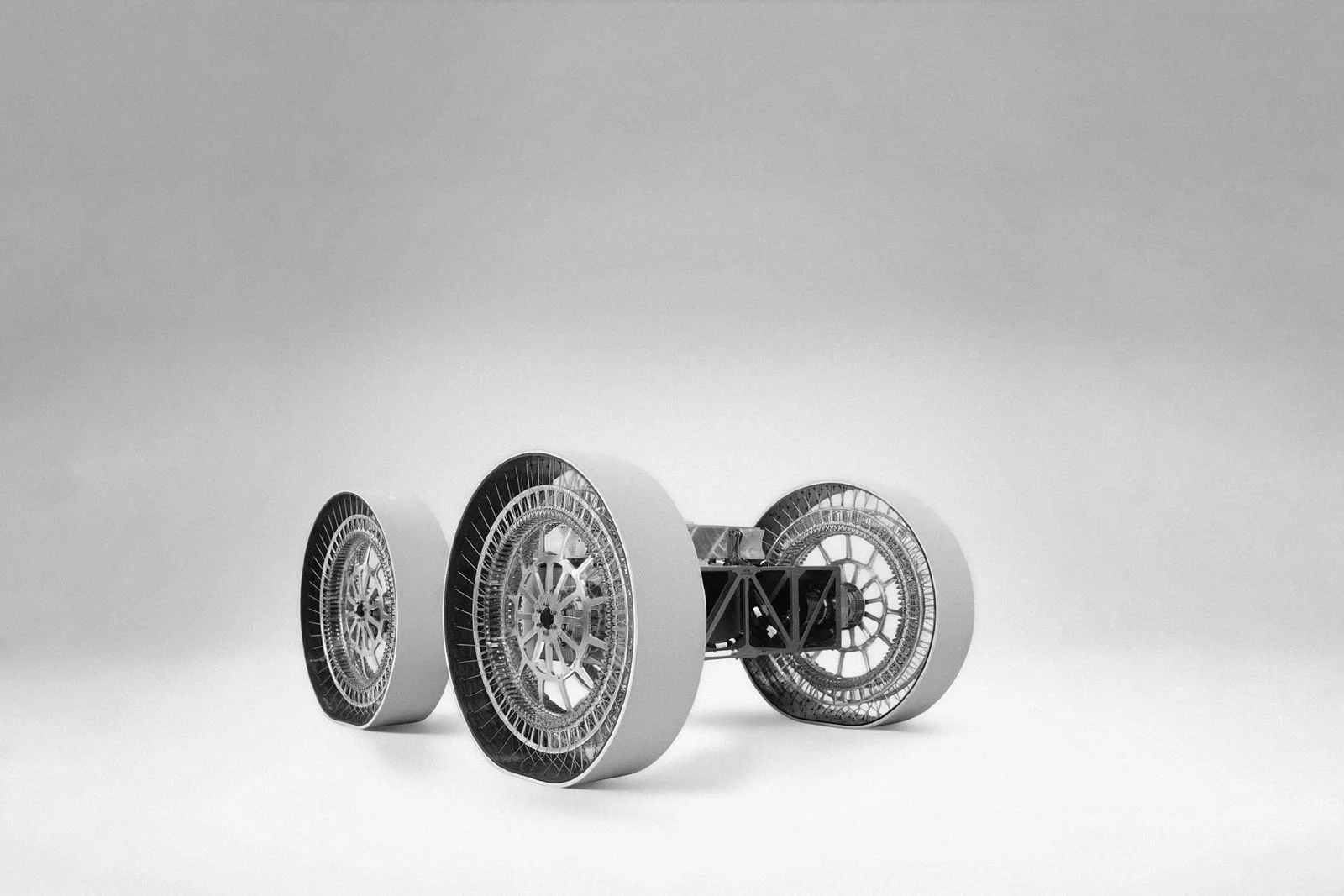
Both watch and rover are currently undergoing Spacecraft Protoflight Qualification testing at Astrolab's Hawthorne, California facility. "It's essentially shake and bake," says Matthews. "There's the bake-out—basically putting the hardware in an oven for an extended period to drive off volatiles; thermal cycling, taking the temperature up and down between extremes many times; and thermal vacuum cycling, doing the same inside a vacuum chamber. We also do electromagnetic interference testing."
Then there's the shake part. "Random vibration on a shaker table that emulates the vibration profile of the launch vehicle and landing. We do shock—quite literally hitting things with a hammer to emulate separation events such as launch vehicle stages separating—and we also do acoustic testing, putting it in a room with speakers blasting sound at it," Matthews says.
All tests must be passed for any component to fly, though given Bremont's track record of using aircraft ejector seat testing for its watches, Cerrato says he isn't worried.
"We are facing conditions and tests we never thought about," he says. "We are looking at numbers for temperature, aging, vibration, and radiation exposure that we never thought we had to put a watch through, but the tests are actually far more extreme than what it will experience during the mission."
Bremont and Astrolab are unlikely to enjoy the lunar limelight alone for long. Following Breitling's news yesterday, today IWC Schaffhausen has also unveiled the Pilot's Venturer Vertical Drive, the brand's first tool watch engineered from the ground up for human spaceflight, and the product of its partnership with Vast, the California-based company building Haven-1, slated to be the world's first commercial space station when it launches into Earth orbit.
Designed for operation by astronauts wearing pressure-suit gloves, the IWC watch dispenses with a conventional crown entirely: all functions, including winding and time-setting, are controlled via a patent-pending rotating bezel and a side-mounted rocker switch.
From a different end of the market entirely, California startup Barrelhand has spent several years developing the Monolith, an EVA-rated mechanical tool watch with a 3D-printed titanium chassis, an "airlock" sealed crown, and a fully ceramic dial engineered to withstand extreme ultraviolet and temperature swings.
All of this is converging in a year in which lunar timekeeping itself becomes a formal discipline. By the end of 2026, the White House has tasked NASA with coordinating a new atomic-clock-based standard, Coordinated Lunar Time, to underpin navigation and communication beyond Earth. The practical implications for a mechanical chronograph fixed to a rover chassis may be close to zero, but there's a pleasing symmetry in the timing all the same. The moment humanity formally agrees how to tell the time on the moon will be the moment there is, at last, a timekeeper sitting on it.