"Developers always take easy path. So if you make the easiest way the right way, then you have the right outcome."— Suneer Pallitharammal Mukkolakal, Lead Platform Engineer, World Bank
This principle guided the World Bank's platform engineering overhaul. The organization compressed infrastructure provisioning from five days of manual work and configuration inconsistencies down to 30 minutes of self-service automation. Their platform now orchestrates 27,000 cloud resources supporting 1,700 applications across Azure, AWS, and GCP.
HCP Terraform became the foundation for building golden paths that embed security, compliance, and best practices by default.
Here's how they standardized their hybrid infrastructure from fragmented "snowflake" pipelines into cohesive platform products.
This analysis draws from a HashiConf session presented by Suneer Pallitharammal Mukkolakal, Lead Platform Engineer at the World Bank.
The hybrid cloud problem
World Bank faced complexity across five dimensions:
Manual operations
Point-and-click operations and ticket-based workflows dominated
Manual configuration across numerous cloud subscriptions
Each manual intervention created technical debt requiring ongoing maintenance
Configuration drift
Development environments bore little resemblance to production
No standardized workflows to prevent environmental divergence
Compliance pressure
Continuous emergence of cyber threats and regulatory requirements
Cloud providers constantly updating products, forcing teams to adapt
Maintaining compliance across fragmented infrastructure proved challenging
Custom applications
Every application treated as unique, requiring bespoke infrastructure
Data teams demanded custom-built data platforms
Application teams required tailored hosting environments
Each request followed the same cycle: requirements gathering → custom design → build → perpetual management
Hundreds of these one-off platforms accumulated across the infrastructure estate
Cognitive overload
Platform teams juggled countless unique configurations
Developers, data engineers, and data scientists navigated complex, inconsistent environments
The catalyst: The CIO launched a digital transformation initiative centered on platform engineering strategy.
Four pillars of platform engineering
World Bank's approach rests on these foundations:
Developer experience
Internal developer portal enabling self-service
Golden paths for applications, data, and AI workloads
Scorecards measuring platform quality and adoption
Security by design
Security policies codified rather than documented in static files
Version control, audit trails, and automated pre-deployment enforcement
Robust secrets management
Security scorecards for transparency
Unified standards
Reusable, composable Terraform modules as building blocks
Modules distributed through an internal private registry in HCP Terraform
Standardized governance through code-based changes and pull request workflows
Versioned standard updates
AI-embedded workflows
Coding assistance for development teams
AI-powered policy validation
Roadmap for AI-generated test cases, intelligent observability, and AI operations
Automated documentation serving both human readers and AI prompt libraries
Building the framework
World Bank implemented their strategy using a pyramid model, constructing from the foundation upward:
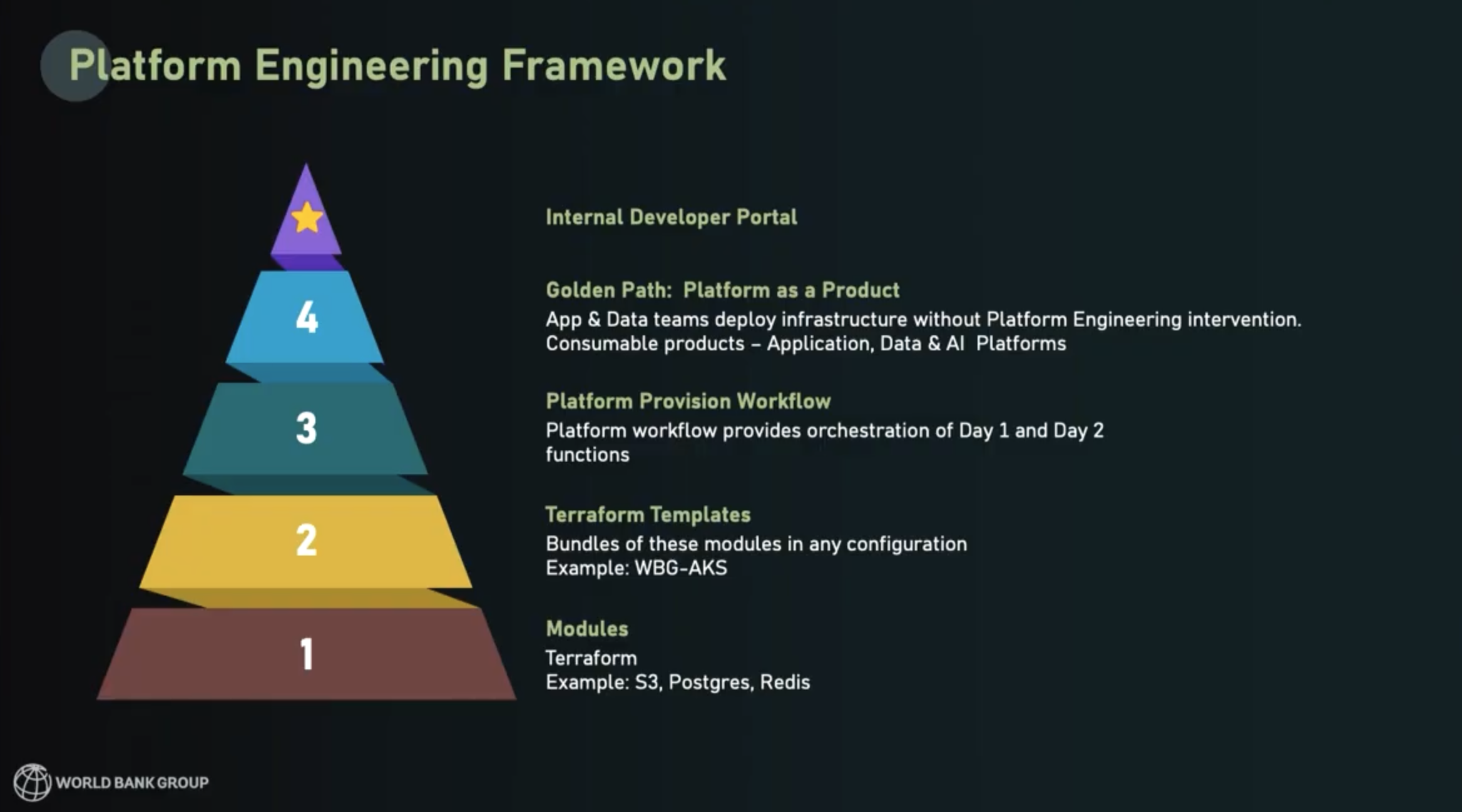
Create infrastructure components as Terraform modules with embedded security hardening and best practices.
Assemble module bundles or "templates" delivering complete, production-ready deployments (HashiCorp note: Terraform Stacks supports this pattern).
Provide workflows orchestrating Day 1 and Day 2 operations with Terraform and complementary tools.
Identify recurring patterns from layers 1-3 and encode them as workflows with built-in best practices and controls. These become golden path options in the platform-as-a-product.
Build the storefront: an internal developer portal.
Self-service Terraform workflow
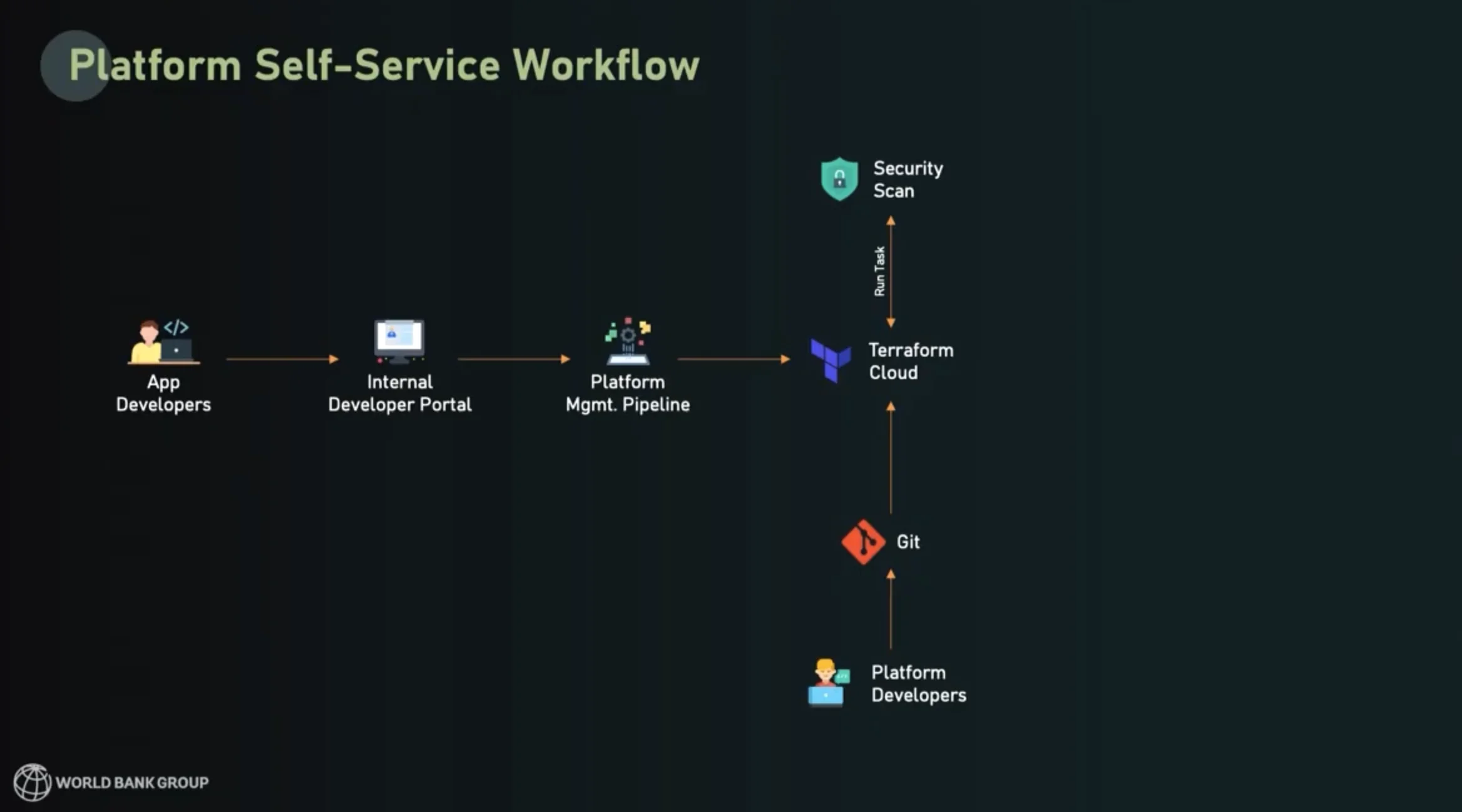
The framework enables developers to access pre-built application stacks through a secure, streamlined process:
Developer requests a golden path product via the IDP
Platform management pipeline activates:
Provisions HCP Terraform workspaces
Pre-populates variables
Connects execution agents
Configures Git repository with golden path definitions
HCP Terraform executes plan and applies golden path patterns
Platform engineers manage operations at the Git repository level, simplifying maintenance across the board.
The workflow's other critical component is shift-left security integration.
Embedded security controls
Integrating security into design and delivery workflows—rather than appending it afterward—reduces rework costs and strengthens security outcomes.
World Bank's security integration works like this:
After Terraform plan completion, the plan routes to security scanning tools via Terraform run task integration.
Security scans execute at the provisioning gateway
Infrastructure deploys only when compliant with security standards
Policy-as-code checks run automatically at this stage
Passing all checks triggers deployment to World Bank's hybrid environment: Azure, AWS, on-premises, and GCP through a unified workflow
The complete self-service workflow appears below:
Architecture perspective
Each standard template balances flexibility with consolidation. World Bank's typical logical architecture for platform deployments includes:
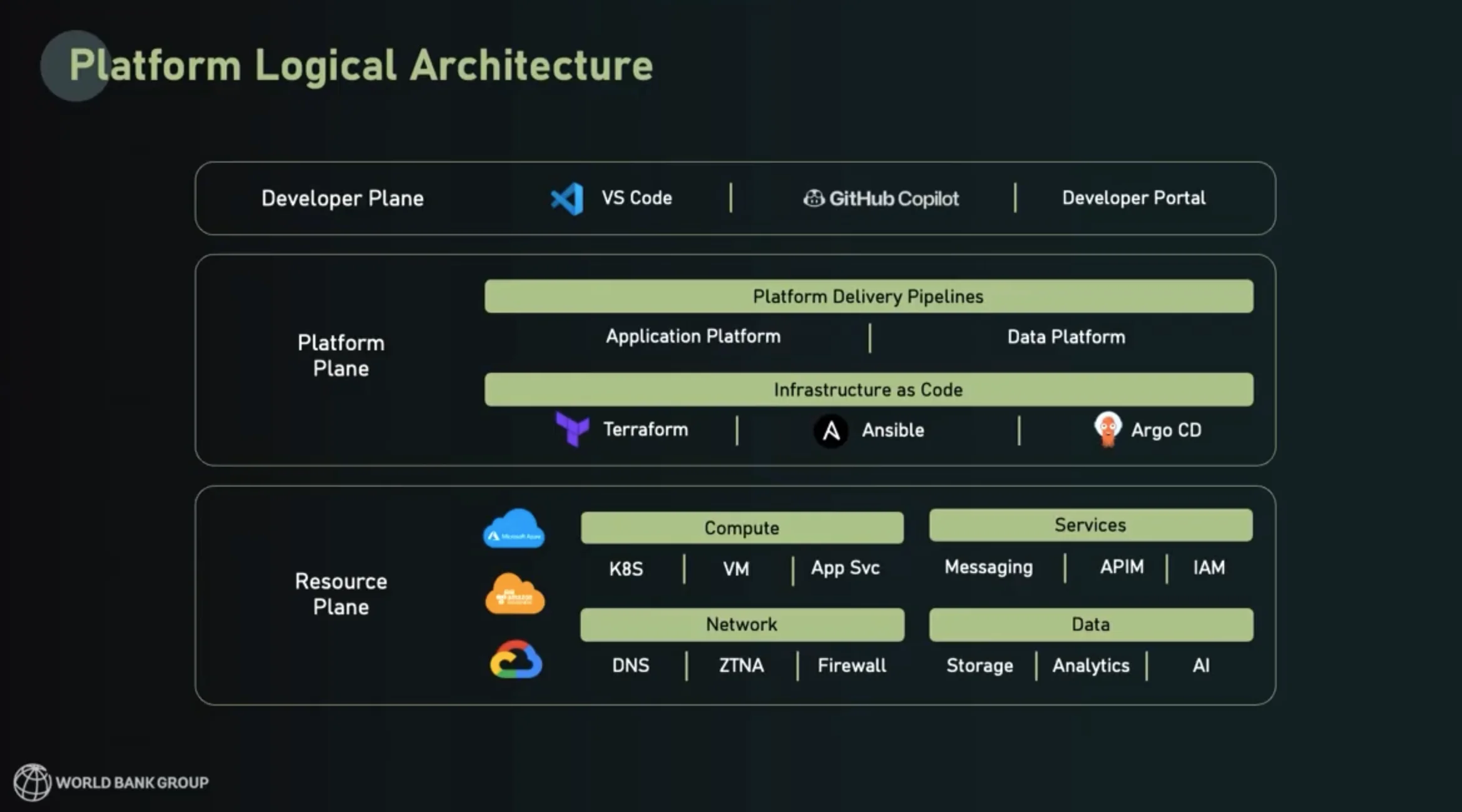
Deployments comprise three planes: resource, platform, and developer.
Resource plane (foundation)
Services from Azure, AWS, GCP, and on-premises infrastructure
Engineers select from compute, network, services, and data options
Platform plane (middle)
Terraform, Ansible, and ArgoCD power platform delivery pipelines
Application and Data platform products delivered as services
Developer plane (top)
Maximum flexibility for developers, data engineers, and data scientists using IDEs, MCP servers, and AI tools like Copilot
Internal developer portal accessible through a web interface
Platform products: Application and data
Suneer outlined World Bank's two primary platform products, highlighting where flexibility matters and where capabilities are mandatory.
Application platform
Core stack:
VNet with network security controls
User interface, API, and database capabilities
Standardized on NodeJS, Java, and .NET (based on existing usage patterns, not mandates)
Database options: PostgreSQL, MySQL, and Cosmos DB (NoSQL)
Optional capabilities (configurable):
Serverless functions (Azure Functions, Lambda-style)
Caching (Redis with embedded security controls)
Object storage for media and files
Security and authentication (mandatory):
Authentication required everywhere
Native authentication preferred
Managed identity for most scenarios
Standard components (always included):
Monitoring, logging, key management, DNS, managed identity
Developers welcomed these standard security and monitoring components—they no longer need to design these integrations themselves. Security and observability come built-in.
The toggle approach allows applications to start minimal, with optional capabilities disabled, then expand as requirements grow.
Suneer also detailed the data platform supporting data products and AI initiatives.
Data platform components
Compute options:
Analytical platforms: large compute clusters like Databricks, AWS EMR
Data movement: Integration platforms such as Data Factory and AWS Glue handle data pipelines
Protected through private endpoints
Storage options:
Data lakes
Relational databases
NoSQL databases
AI capabilities:
Vector databases enable retrieval augmented generation (RAG)
LLM APIs from Azure, OpenAI, Claude, and other providers
Security:
Platform-wide integration with private endpoints and private links across cloud vendors
Robust key management system for database connections
The toggle approach delivers a crucial advantage: teams can add capabilities without requesting platform support. The flexibility built into these platform products enables true self-service operations.
Day 2 operations for platform engineers
Platform teams experienced dramatic productivity gains after developing these platform products. Rather than maintaining dozens of custom processes and responding to individual change requests, they could manage and maintain infrastructure in bulk at scale. Key improvements include:
Complete GitHub-based management with infrastructure codified in Terraform
Rapid version changes at scale—when security vulnerabilities emerge in cloud vendor products, teams update the Terraform module and release a new version
Security and compliance stakeholders can modify checks and policy code in a scalable, versioned manner
Key results: From days to minutes
The World Bank's platform strategy delivered measurable impact across three critical areas:
Greater delivery velocity
Infrastructure provisioning time dropped from 5 days to 30 minutes
The 30-minute figure represents pure execution time
Standardized infrastructure across the org
70% of teams now use standardized platform offerings
Built-in optionality within golden paths ensures consistent service consumption
Organic growth in standardization across the organization
Scale and reach
Deployed 27,000 cloud resources in record time
Supporting 1,700 applications using these patterns alone
Maintained security, consistency, and compliance throughout
Lessons learned
The World Bank identified six critical lessons from this transformation:
Start small, standardize, and automate relentlessly
Begin with a single bottleneck
Automate end-to-end processes from the outset
Adopt modular, flexible architectures
Avoid overengineering Terraform modules
Resist excessive configurability
Build minimum viable modules for templates, then iterate based on real needs
Apply team topologies and agile ways of working
Essential when coordinating multiple teams: security, development, data science, and compliance
Cross-functional collaboration drives incremental progress
Team topologies provided structure and clarity across groups
Have clarity on the patterns that serve a majority of use cases
Attempting to standardize workflows for 100% of enterprise use cases guarantees failure
Bespoke "snowflakes" will always exist—handle them separately
Embed AI in platform engineering workflows effectively
Policy checks
Coding assistance
AI-powered automation throughout the platform
Make the easy path the right path
Developers want to build secure, compliant applications, but platform teams must make that path frictionless. When compliance becomes too difficult, developers route around it, creating shadow IT. Reducing operational overhead in development workflows frees developers to focus on creative work that delivers business value.
"Your developers' creative work truly begins where their wait time ends." — Suneer Pallitharammal Mukkolakal, Lead Platform Engineer, World Bank
To learn more about how we can help your company navigate the complexities of hybrid infrastructure for more secure, automated operations, read our guide to navigating cloud complexity and drop us a line to talk about your unique IT challenges.
Watch the full session from HashiConf below: